28 April 2026 |  News
News
What are flexible barriers?
Industrial protections
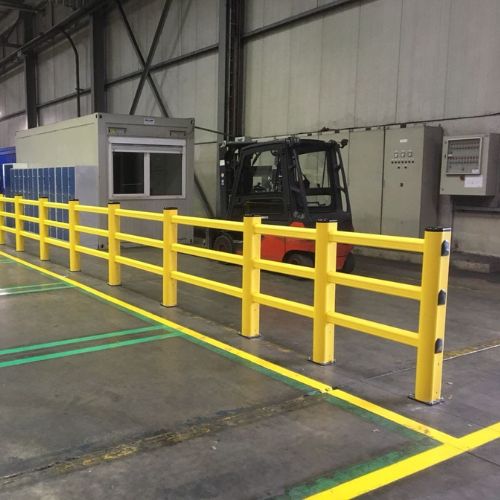
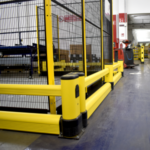
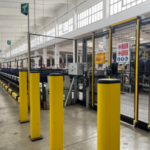
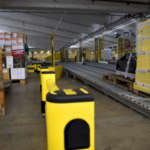
Flexible barriers are structures, typically installed in industrial settings and warehouses, that are designed to absorb impacts and return to their initial shape.
They are the best alternative to steel barriers, given they outperform them in all important aspects. Flexible protections are capable of absorbing multiple hits without needing replacements or losing their impact strength.
Tipically, their main functions are to:
- Clearly define viability and give drivers and workers clear visual indicators
- Protect all types of structures (like racks and columns) from forklift collisions
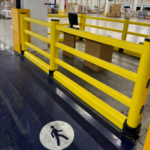
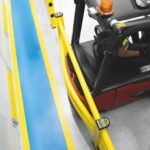
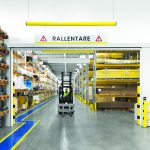
- Separate pedestrian and vehicle areas and provide protection against collisions
HOW DO THEY WORK?
The way flexible barriers work is simple, yet brilliant. Being made of “plastic” polymers, absorbing impacts from vehicles like forklifts and deforming temporarily.
This deformation dissipates the kinetic energy from the impact in a controlled way, thus stopping the vehicle and avoiding damage to all protected structures, including floors and fixings.
Being made of highly flexible and elastic materials, they can then return to the initial shape and still be fully functional to absorb other hits.
WHAT ARE THE ADVANTAGES?
Apart from the obvious reasons of increasing safety in a warehouse/plant and preventing harm to people and structures, flexible protections offer yet more advantages over metal ones.
- Cost-effectiveness: While the initial cost of flexible barriers is generally higher than metal ones, over the long run flexible barriers will be cheaper. This happens because steel protections deform permanently after impact and need frequent replacements.
- Lower maintenance: PVC-based flexible barriers require very little maintenance in comparison with metal ones. They don’t need repainting or substitution for each hit, saving loads of time and money. Operational continuity is always protected and downtimes are kept to a minimum.
- Visual Clarity: Flexible protections are designed immediately visible even with low lighting. This is because they highlight important pathways and places where there’s risk of accidents. Their bright yellow color is meant to be instantly recognizable and to capture the attention of drivers and pedestrians.
- Ease of use: Flexible barriers are designed to be modular and easier to handle. Ease of installation and relocation are key. Our barriers in particular are among the only ones that can be modified on the spot with the Genius System, bringing personalization to a whole other level.
- Softer impacts: Being flexible, these types of protections cushion the impact for the driver as well. Since the impact does not come to a sudden stop like with metal barriers, the backlash on the driver is much more controlled and manageable. Flexible barriers should be studied, in accordance with UNI 11886, to have a low ASI score. ASI is an index that is used to measure the effect of an impact on the driver. This calculation is taken into account when designing barriers.
WHY SHOULD YOU CHOOSE MPM PVC BARRIERS
At MPM we are not simply safety experts; we are innovators in the field of flexible barriers.
This lead us down our own path of invention and innovation.
Unlike most competitors, who use mainly PP, MPM produces barriers with a PVC-based polymer.
Obviously, our materials like Reflex, Reflex Alpha and Frostex are highly engineered and specialized compounds, not “ordinary” PVC.
This choice has helped us to capture the best of both worlds, combining the best qualities of PVC with high flexibility and impact resistance.
In particular, our protections are the only ones in the market that are classified as V0 according to UL94 Standards. This means they are self-extinguishing and do not propagate flames.
Another advantage of our materials is that they can help us design less bulky barriers. Our unique design is smaller than other flexible barriers while still maintaining the same impact resistance.
This means less operational space is wasted and spaces can be further optimized.
The unique design of our products has led to another innovation, a truly simple assembly system.
With only few pieces, easy to assemble by an in-house installation team, you can have a high impact resistance barrier. This saves time and reduces costs and operational downtime. It also makes maintenance, when needed, far quicker.
IN CONCLUSION
In today’s fast-paced industrial environments, flexible barriers represent a smarter approach to industrial safety, combining durability, visibility, and long-term cost savings in a single solution.
Choosing the right barrier system is not just about preventing damage, but also about creating a safer, more efficient workspace where people, structures and operations are all protected.
With MPM’s continuous focus on innovation, material engineering and practical design, flexible PVC barriers are not just an alternative to steel, they are the future of industrial safety.